Dictionary of Heretics, Dissidents, and Inquisitors in the Mediterranean World
Edizioni CLORI | Firenze | ISBN 978-8894241600 | DOI 10.5281/zenodo.1309444
HOW TO CITE | EDITORIAL GUIDELINES | CODE OF CONDUCT | LIST OF ABREVIATIONS
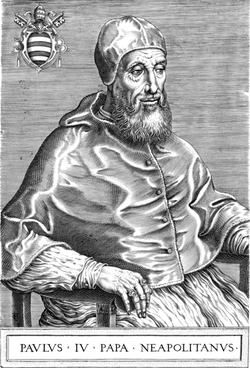
Paul IV, born Gian Pietro Carafa (Sant’Angelo a Scala or Capriglia, 28 June 1476 – Rome, 18 August 1559), was pope from 1555 to 1559. A Neapolitan with an impulsive and stubborn character, he is indisputably to be considered the “father” of the Holy Office, the “new” Inquisition which he led from 1542 onward after having strongly advocated its institution with Paul III.
|
Summary
|
Biography
Family background and beginnings of his ecclesiastical career
From a noble Neapolitan family, he was born on 28 June 1476 in the baronial territory of Sant’Angelo a Scala, in the Avellino area (the sources are unclear whether precisely in Sant’Angelo a Scala or in Capriglia), the son of Giovanni Antonio Carafa and Vittoria Camponeschi. He was introduced into Roman circles by his powerful uncle, Cardinal Oliviero Carafa (1430–1511): the first step of his Curial career was his appointment as papal secret chamberlain in 1500 (under Alexander VI), followed in 1503 (under Julius II) by his appointment as protonotary apostolic.
On 30 July 1505 he was appointed bishop of Chieti: he resided stably in that diocese from 1507 to 1513, devoting much care to reforming activity.
Diplomatic missions
In the first two decades of the century he undertook various diplomatic missions in the service of the Holy See: he was extraordinary legate of Pope Julius II to Naples at the court of Ferdinand the Catholic in 1506–07; he then served as nuncio of Leo X in England at the court of King Henry VIII from 1513 to 1515 and, after staying in the Low Countries with the regent Margaret of Austria until 1517, he accompanied the young King Charles to Spain in September of that year, remaining there until early 1520. Although not much favored by the future emperor, the latter proposed him for the bishopric of Brindisi: the appointment was ratified in the consistory of 20 December 1518, without Carafa relinquishing the bishopric of Chieti.
Return to Italy: commitment to Church reform
From 1520 he took part in the Roman activities of the Oratory of Divine Love, within which he met many future friends and collaborators, among them Gaetano di Thiene, Paolo Consiglieri and Gian Matteo Giberti. Together with Gaetano di Thiene he founded in 1524 the Order of Clerics Regular, more commonly called the Theatines (from the Latin name of the city of Chieti), renouncing in that same year his two bishoprics.
The Venetian sojourn
In May 1527 he witnessed the Sack of Rome carried out by Charles V’s Landsknechts. Escaping the violence, he made his way from the papal city to Venice in June 1527, settling with his Theatines at the oratory of San Nicola da Tolentino. During the long Venetian stay, which lasted until 1536, Carafa devoted himself to the organization and development of the Theatine order, for which he obtained important papal concessions in 1529 and 1533. Under his leadership, they engaged in intense preaching and propaganda against heretics and for the reform of the Church throughout the territory of the Republic of Venice. Close relations were maintained with a great friend of Carafa’s: Gian Matteo Giberti, bishop of Verona, whom Carafa assisted on several occasions (from 1527 onward) in the reform of his diocese. In 1528–29, on behalf of Pope Clement VII, Carafa successfully labored to bring the Greek community of Venice into submission to the Church of Rome; from 1530 he proceeded against friar Girolamo Galateo and other Conventual Franciscans suspected of heresy. The Venetian sojourn was for Carafa a crucial period of reflection on the condition of the Church and of elaboration of ideas that he would later attempt to implement as head of the “new” Inquisition and then as pontiff. A mature expression of these ideas was the memorandum (De Lutheranorum haeresi reprimenda et ecclesia reformanda ad Clementem VII) which Gian Pietro Carafa sent to Clement VII from Venice in 1532, in which the future Paul IV lamented the spread of heretics and the corruption of the clergy in Venice and its Dominion, and suggested to the pope the lines of action to be followed to remedy it. From his analysis of the particular Venetian religious situation Carafa moved to propose solutions applicable on a much broader scale: to remedy the spread of the “plague” of “Lutheran heresy” in the Republic of Venice—fueled above all by “apostates” (wandering religious) as well as by the “accursed brood” of certain Conventual Franciscans (among them Galateo and Bartolomeo Fonzio)—it was necessary, among other things, to control and discipline the activity of preachers and confessors, impose the obligation of residence on bishops, prevent priestly ordinations performed for money, act against the circulation of heretical books, and reform the religious orders. But the most effective remedy, in Carafa’s view, remained the Inquisition, which had to be taken out of the hands of inept Friars Minor and completely reorganized.
Return to Rome: creation as cardinal; intransigents vs. spirituali
In September 1536 Paul III recalled Gian Pietro Carafa to Rome to serve on the commission charged with drafting the Consilium de emendanda ecclesia, and on 22 December of that same year created him cardinal. From his return to Rome, Carafa established himself as the undisputed leader of the Curial party of the “intransigents,” who, faced with the disorder created by the Protestant Reformation, championed a rigid, austere, and dogmatic religiosity and closed every door to dialogue, conceiving the violent repression of any form of doctrinal deviation as the sole remedy. The most dangerous opponents, in Carafa’s eyes, were precisely those figures who, remaining within the Roman Church, advocated instead a reconciliation with the Protestants on the basis of a highly interiorized conception of religion that devalued works and exterior practices and rested on a few fundamentalia fidei: the nascent group of the “spirituali.”
At the head of the new Inquisition
Thus, while irenic currents made a desperate attempt to mend the Protestant schism— in 1541 the Colloquy of Regensburg took place with the participation of Cardinal Gasparo Contarini, the “spirituali”’s point of reference, who died the following year—Carafa pressed Paul III to embark on the path of the harshest repression of religious dissent: on 21 July 1542, with the bull Licet ab initio, and yielding precisely to Carafa’s advice and pressure, Paul III instituted the Congregation of the Holy Office, the “new” Inquisition, at the head of which Carafa himself was placed, assisted by five other cardinal inquisitors. Through his leadership of the Holy Office, Gian Pietro Carafa succeeded in acquiring the prestige and power that later enabled his ascent to the papacy. The Inquisition was used as a powerful instrument to discredit opponents in the Curia: in 1549 Gian Pietro Carafa brought inquisitorial documents into the conclave against Cardinal Reginald Pole to prevent his election as pope. In turn, the hostility of Emperor Charles V, protector of the “spirituali” cardinals Reginald Pole and Giovanni Morone, grew against the Neapolitan cardinal: in that same year Charles V prevented Carafa from taking possession of the archbishopric of Naples and also placed a heavy veto on his possible election to the papal throne. The death of Paul III (1549) and the election of Julius III (1550) did not at all curb Carafa’s inquisitorial impetus: the inquiry against Cardinal Morone was launched precisely under the new pope without his knowledge; Julius III ordered the dismissal of the case, but Carafa dramatically refused to obey. The bishop of Bergamo, Vittore Soranzo, whose pastoral activity had made him suspect of Lutheranism, was summoned to Rome in 1551, arrested, and subjected to a trial that ended with his abjuration. The protection of his “spirituali” friends was crucial in mitigating the outcome of that trial: effectively “pardoned” by Julius III, who personally intervened against Cardinal Carafa, in 1554 Soranzo was then reinstated in his diocese.
The papacy
War against the Spanish and subsequent reconciliation with Philip II
The new papacy was entirely marked by the struggle against heretics and infidels— not by chance one of Paul IV’s first acts was the anti-Jewish bull Cum nimis absurdum (14 July 1555)—a category which, in Pope Carafa’s view, came to include even sovereigns such as Charles V and Philip II. Paul IV conceived his war against the Spanish as a “crusade of Christian shields” against a “heretic emperor” and his son, who showed himself to be following in his father’s footsteps, as emerges very clearly from his conversations with the Venetian ambassador Bernardo Navagero, with whom Pope Carafa developed a special rapport of confidence and sympathy. Beyond personal resentments, Paul IV reproached Charles V for having been too tolerant toward the German Protestants, showing that he had ill-stomached both the Interim (1548) and the subsequent Peace of Augsburg (1555), and in Spain for having favored the “spiritual” heresy, from which Juan de Valdés came, who had introduced the new religious trends into Italy through his Neapolitan circle. The war, begun in September 1556 after a year of tensions following the expropriation of the Colonna’s papal fiefs (protected by the imperial party), had a catastrophic outcome despite the French alliance: the troops of the Duke of Alba, viceroy of Naples, advanced to the gates of Rome, and the French were forced to withdraw their military support for the pontiff following their sensational defeat in the Low Countries at Saint-Quentin (10 August 1557). The Peace of Cave in September 1557 marked the end of hostilities. From then on Paul IV’s attitude toward Philip II changed radically, and not only for reasons of political expediency: in the briefs sent to the new king of Spain from late 1557 onward there are expressions of esteem for the young sovereign, previously so reviled, motivated above all by his full support for the Spanish Inquisition, led by the intransigent archbishop of Seville, Fernando de Valdés, who at that juncture launched his powerful offensive aimed at crushing the Spanish front of the “spirituali,” gathered around Bartolomé Carranza, archbishop of Toledo from 1557.
The persecution of heretics: the offensive against the spirituali and the strengthening of the Holy Office
While planning and then implementing the political-military offensive against Charles V and Philip II, Paul IV naturally gave new impetus to inquisitorial investigations: thus he threw Morone into the prisons of Castel Sant’Angelo (the arrest took place on 31 May 1557), subjecting him to an exhausting inquisitorial process (the predictably harsh consequences of which Morone escaped only thanks to Paul IV’s death in August 1559, being rehabilitated by his successor Pius IV); he revoked Cardinal Pole’s English legation, recalling him to Rome with the evident aim of putting him publicly on trial (but the English cardinal, protected by Queen Mary Tudor and by Philip II, remained in his country, where he died on 17 November 1558); he tried in absentia the Florentine Pietro Carnesecchi, formerly a protonotary of Clement VII, protected by the Duke of Florence Cosimo de’ Medici, and Vittore Soranzo, reopening the case against him which had ended harmlessly under Julius III: this time, however, the trial concluded with a very severe sentence on 20 April 1558 (but Soranzo, gravely ill and protected by his government, died at home on 15 May of that same year). Overall, under Paul IV the Holy Office greatly expanded its sphere of action and its competencies: the congregation came to count as many as fifteen members (at the beginning of the pontificate the cardinal inquisitors were only four), extended its remit to offenses such as blasphemy, homosexuality, and even simony—since the fight against the latter was explicitly at the center of its work of Church reform—and effectively established itself as the most important Roman cardinal congregation. It also fell to the Holy Office to draft the first Roman Index of Forbidden Books (1559). Paul IV thus initiated that process of development of the Holy Office that reached full completion in 1588, when Sixtus V officially ratified the preeminent position of this congregation over all other Roman congregations.
Management of cardinalatial appointments
Paul IV’s creations of cardinals were also marked by his concern for the defense of orthodoxy, though other needs had to be considered as well. Pope Carafa generally favored the rise of figures distinguished by the integrity of their faith, often disregarding princes’ claims to have their own trusted men at the top of the ecclesiastical hierarchy: among his 19 creations stand out those of Giovanni Battista Scotti, an early Theatine; the theologian Johann Gropper; the intransigent archbishop of Toledo Juan Martínez Silíceo, former tutor of Philip II and persecutor of the conversos (20 December 1555); Clemente Dolera, Minister General of the Friars Minor; and Michele Ghislieri (15 March 1557). To this Dominican friar of humble origins, distinguished by his inquisitorial zeal and already risen to Commissary-General of the Holy Office, Paul IV had assigned on 1 September 1555 the same full powers as the cardinal inquisitors; then, on 4 September 1556, he appointed him bishop of Nepi and Sutri. Ghislieri’s career under Paul IV culminated with his lifetime appointment as Grand Inquisitor (inquisitor maior et perpetuus), made on 14 December 1558. Thanks to Paul IV and the Holy Office, Ghislieri thus managed to make that qualitative leap and to obtain the authority and prestige in the Curia that allowed him in turn, in January 1566, to ascend to the papal throne as Pius V, thereby continuing the work of his “master.” Another cardinalate was closely connected, albeit indirectly, with inquisitorial affairs: the elderly English Franciscan William Peto was created cardinal (14 June 1557) because he was chosen by Paul IV as substitute for Pole in the English legation.
Relations with his nephews
The first cardinal he created was Carlo Carafa (7 June 1557), who, as “cardinal-nephew,” played a leading role in managing the Papal States’ internal and foreign policy: Paul IV did not in the least break with the nepotistic policy of his predecessors, greatly favoring his other two nephews as well—Giovanni Carafa, Duke of Paliano and Captain General of the Church, and Antonio Carafa, Marquis of Montebello—and creating as cardinal the very young son of the latter, Alfonso Carafa (15 March 1557), as well as another relative, Diomede Carafa, bishop of Ariano (20 December 1555). This lasted at least until January 1559, when, exasperated by the conduct of the three nephews, he stripped them of every office and banished them from Rome.
The final months: the Sacred Council and the acceleration of reform
The government of the Papal State was then entrusted to a new and original body, the Sacred Council, in many respects a forerunner of the Consulta (established in 1587 by Sixtus V) but with far broader competencies; and, once rid of his nephews, in the final months of his life Paul IV further accelerated his work of Church reform.
Paul IV in contemporary judgment and his legacy to the Counter-Reformation Church
The ill-fated war obstinately waged against the Spanish, the terrible reputation of his nephews, and his incredible intransigence in persecuting heretics alienated Paul IV from his contemporaries. At his death, on 18 August 1559, the Roman populace rose up, sacked the palace of the Inquisition, and defaced his statue. His successor, Pius IV, among the first acts of his papacy, brought Carlo and Giovanni Carafa to trial and condemned them to death.
Early modern historiographers of the Counter-Reformation who dealt with Paul IV were divided between those who saw in him a “saint” (Theatine historiography) and those who branded him an unworthy pontiff. His figure and pontificate nonetheless remain indissolubly linked to the Inquisition, which he skillfully reshaped and reorganized, effectively making the Holy Office the most important organ of the Roman Church— a role it would firmly retain in the centuries to come.
Bibliography
- Alberto Aubert, Paolo IV. Politica, Inquisizione e storiografia, Le Lettere, Florence 1999 [formerly Paolo IV nel giudizio dell’età della Controriforma, Stamperia Tiferno Grafica, Città di Castello, 1990].
- Alberto Aubert, Paolo IV, in EP, vol. 3.
- Alberto Aubert, Paolo IV, papa, in DBI, vol. 81 (2014).
- Giampiero Brunelli, Il Sacro Consiglio di Paolo IV, Viella, Rome 2011.
- Massimo Firpo, Inquisizione romana e Controriforma. Studi sul cardinal Giovanni Morone (1509–1580) e il suo processo d’eresia. New revised and expanded edition, Morcelliana, Brescia, 2005.
- Massimo Firpo, Vittore Soranzo vescovo ed eretico. Riforma della Chiesa e Inquisizione nell’Italia del Cinquecento, Laterza, Rome–Bari 2006.
- Martina Mampieri, Living under the Evil Pope. The Hebrew Chronicle of Pope Paul IV by Benjamin Neḥemiah ben Elnathan from Civitanova Marche (16th cent.), Brill, Boston–Leiden 2019.
- Gennaro Maria Monti, Ricerche su papa Paolo IV Carafa, Cooperativa Tipografi Chiostro Santa Sofia, Benevento 1923.
- Pio Paschini, S. Gaetano Thiene, Gian Pietro Carafa e le origini dei chierici regolari teatini, Scuola tipografica Pio X, Rome, 1926.
- Ludwig von Pastor, Storia dei Papi dalla fine del Medio Evo, vol. VI, Storia dei Papi nel periodo della Riforma e Restaurazione cattolica. Giulio III, Marcello II e Paolo IV (1550–1559), Desclée, Rome, 1922 EN.
- Miles Pattenden, Pius IV and the Fall of The Carafa: Nepotism and Papal Authority in Counter-Reformation Rome, Oxford University Press, Oxford 2013.
- Daniele Santarelli, Il papato di Paolo IV nella crisi politico-religiosa del Cinquecento. Le relazioni con la Repubblica di Venezia e l’atteggiamento nei confronti di Carlo V e Filippo II, Aracne editrice, Rome, 2008.
- Daniele Santarelli, Il papato di Paolo IV nella crisi politico-religiosa del Cinquecento. Nota critica, bibliografia, indice dei nomi, Aracne editrice, Rome 2012.
- José Ignacio Tellechea Idígoras, El arzobispo Carranza. “Tiempos recios”, vols. I–IV, Publicaciones Universidad Pontificia – Fundación Universitaria Española, Salamanca 2003–2007.
- Andrea Vanni, “Fare diligente inquisitione”. Gian Pietro Carafa e le origini dei chierici regolari teatini, Viella, Rome 2010.
Links
- Entry on Paul IV on Symogih.org
Related entries
Further reading
Nota bene
This entry is a reworking, with some modifications and additions, of a text originally published in Dizionario storico dell’Inquisizione, edited by Adriano Prosperi in collaboration with Vincenzo Lavenia and John Tedeschi, Edizioni della Normale, Pisa 2010, vol. 3, pp. 1164–66.
Article written by Daniele Santarelli | Ereticopedia.org © 2013–2025
et tamen e summo, quasi fulmen, deicit ictos
invidia inter dum contemptim in Tartara taetra
invidia quoniam ceu fulmine summa vaporant
plerumque et quae sunt aliis magis edita cumque
[Lucretius, "De rerum natura", lib. V]