Dictionary of Heretics, Dissidents, and Inquisitors in the Mediterranean World
Edizioni CLORI | Firenze | ISBN 978-8894241600 | DOI 10.5281/zenodo.1309444
HOW TO CITE | EDITORIAL GUIDELINES | CODE OF CONDUCT | LIST OF ABREVIATIONS
Carlo Ginzburg (Turin, 15 April 1939 – Bologna, 17 June 2026) was an Italian historian.
Biography and Scholarly Activity
The son of Leone Ginzburg and Natalia Ginzburg (née Levi), he graduated and pursued advanced studies at the Scuola Normale Superiore in Pisa, where he was a student of (among others) Delio Cantimori. He taught for many years at the University of Bologna and subsequently held the Chair of Italian Renaissance History at the University of California, Los Angeles (UCLA) from 1988 to 2006. In 2006 he was appointed Professor of the History of European Cultures at the Scuola Normale Superiore in Pisa, where, following his retirement, he was awarded the title of Professor Emeritus.
The principal focus of his research, which ranged across history, anthropology, and art history, concerned the history of mentalities and cultures in the sixteenth and seventeenth centuries.
His name is also associated with Microhistory, a historiographical current that proved particularly influential during the 1980s (although other historians linked to that school, such as Giovanni Levi and Edoardo Grendi, criticized Ginzburg’s excessive emphasis on cultural dynamics at the expense of social ones, which they regarded as central to Microhistory).
His books achieved remarkable international visibility, were translated into numerous languages, and made him one of the best-known Italian intellectuals abroad. The work to which he owes much of his fame is Il formaggio e i vermi. Il cosmo di un mugnaio del '500 (1976), a reconstruction of the life and thought of the Friulian miller Menocchio, who was condemned to death by the Inquisition.
His interpretations, however, were often subjected to serious criticism by other specialists, generally on the basis of more extensive readings of the sources. According to several critics, Ginzburg displayed a tendency to construct theories and interpretations from a priori assumptions that were not always sufficiently grounded in empirical evidence: “a certain forcing of the documents is evident,” remarked Giovanni Romeo regarding Ginzburg’s studies of the Friulian benandanti1. Particularly significant was the observation made by Dominick LaCapra concerning the book on Menocchio, which, in his view, reflected less the worldview of a sixteenth-century miller than that of a twentieth-century historian (“the cosmos of a twentieth century historian”): namely, Ginzburg himself2. During the controversy that followed the publication in February 2007 of Pasque di sangue by Ariel Toaff, against whose theses Ginzburg intervened particularly harshly, Franco Cardini in turn observed: “Are the errors he [Ginzburg] attributes to Toaff really more serious than those for which he himself was criticized, especially the ‘chronologie … contestable’ reproached by Martine Ostorero in her Folâtrer avec les démons (Lausanne 1995, p. 17) concerning his Storia notturna? Does he recognize himself in the portrait of his scholarly work offered by Oscar di Simplicio in the Encyclopedia of Witchcraft. The Western Tradition, edited by Richard M. Golden (Santa Barbara 2006, pp. 443–44), particularly with regard to his use of the ‘evidential paradigm’, which, according to his critic, remains insufficiently anchored in the sources?”3.
In 1979 Ginzburg addressed a letter to Pope John Paul II, advocating the opening of the Roman archives of the former Holy Office to scholars. Although the letter received no reply, it presumably played a role in initiating the process that led to the opening of the archives of the former Holy Office to the public in 1998.
His intervention in defence of Adriano Sofri, a close friend and former fellow student at the Scuola Normale, was also widely debated. Accused of involvement in the murder of Police Commissioner Luigi Calabresi, Sofri was convicted at first instance in 1990 and definitively in 1997 as the instigator of that politically motivated terrorist murder. In Il giudice e lo storico, published by Einaudi in 1991, Ginzburg applied methodologies similar to those employed in his studies of witchcraft and its judicial persecution, drawing a parallel between the Sofri trial and the witchcraft trials conducted by the Inquisition in the sixteenth and seventeenth centuries.
Major Works
- I benandanti. Ricerche sulla stregoneria e sui culti agrari tra Cinquecento e Seicento, Einaudi, Turin 1966.
- I costituti di don Pietro Manelfi, Sansoni–The Newberry Library, Florence–Chicago 1970.
- Il nicodemismo. Simulazione e dissimulazione religiosa nell'Europa del '500, Einaudi, Turin 1971.
- Giochi di pazienza. Un seminario sul Beneficio di Cristo, Einaudi, Turin 1975 (with Adriano Prosperi).
- Il formaggio e i vermi. Il cosmo di un mugnaio del '500, Einaudi, Turin 1976.
- Indagini su Piero. Il Battesimo, il ciclo di Arezzo, la Flagellazione di Urbino, Einaudi, Turin 1981 (new edition with four additional appendices, Einaudi, Turin 1994).
- Miti emblemi spie. Morfologia e storia, Einaudi, Turin 1986.
- Storia notturna. Una decifrazione del sabba, Einaudi, Turin 1989.
- Il giudice e lo storico. Considerazioni in margine al processo Sofri, Einaudi, Turin 1991.
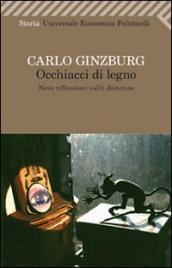
- Occhiacci di legno. Nove riflessioni sulla distanza, Feltrinelli, Milan 1998.
- Rapporti di forza. Storia, retorica, prova, Feltrinelli, Milan 2000.
- Nessuna isola è un'isola. Quattro sguardi sulla letteratura inglese, Feltrinelli, Milan 2002.
- Il filo e le tracce. Vero falso finto, Feltrinelli, Milan 2006.
- Paura, reverenza, terrore, Adelphi, Milan 2015.
- Nondimanco. Machiavelli, Pascal, Adelphi, Milan 2018.
- La lettera uccide, Adelphi, Milan 2021.
- Il vincolo della vergogna, Adelphi, Milan 2026.
In depth
- Carlo Ginzburg (1939–2026): Between Innovation and Controversy
- Carlo Ginzburg after Carlo Ginzburg: Reassessing a Master
Links and Further Reading
- Interview with Carlo Ginzburg on the website of the Swiss Radio and Television
- Franco Cardini, Storici, il paradigma censurato. Risposta a Ginzburg sulla libertà di ricerca, "Avvenire", 28 February 2007
- Dominick LaCapra, The Cheese and the Worms. The cosmos of a twentieth century historian, in Id., History and criticism, Cornell University, Ithaca 1985, pp. 45–69
- Dominick La Capra, Intellectual history and his ways, "The American Historical Review", 97-2, Apr. 1992
- John J. Martin, Journeys to the World of the Dead: The Work of Carlo Ginzburg, in "Journal of Social History" 25-3, 1991, pp. 613–626
- Alexander Stille, When History Gets Personal; How an Italian Scholar Turned Advocate in a Terrorist Case, "New York Times", 11 March 2000
- Justo Serna, Anaclet Pons, El historiador como autor. Éxito y fracaso de la microhistoria, in "Prohistoria", no. 3, 1999, pp. 237–260
- David Levine, Zubedeh Vahed, Ginzburg's Menocchio: Refutations and Conjectures, in "Social History/Histoire sociale", vol. 34, no. 68, 2001, pp. 437–464
Related Entries
Article written by Redazione | Ereticopedia.org © 2014-2026
et tamen e summo, quasi fulmen, deicit ictos
invidia inter dum contemptim in Tartara taetra
invidia quoniam ceu fulmine summa vaporant
plerumque et quae sunt aliis magis edita cumque
[Lucretius, "De rerum natura", lib. V]