Dictionary of Heretics, Dissidents, and Inquisitors in the Mediterranean World
Edizioni CLORI | Firenze | ISBN 978-8894241600 | DOI 10.5281/zenodo.1309444
HOW TO CITE | EDITORIAL GUIDELINES | CODE OF CONDUCT | LIST OF ABREVIATIONS
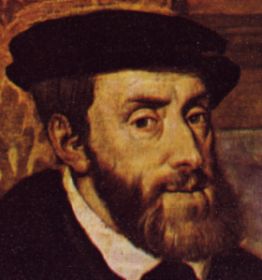
Charles V of Habsburg (Ghent, 24 February 1500 – Monastery of Yuste, 21 September 1558), Holy Roman Emperor and King of Spain, was a ruler who embodied great hopes of universal renewal. A protector of humanists, he had to face the French politico-military challenge to his hegemony on the European chessboard, the spread of the Protestant Reformation (particularly in Germany), and the Turkish advance in the Mediterranean. The substantial failure of his political project opened the door to the age of the Counter-Reformation and the wars of religion.
|
Summary
|
Biography

Family and Education
Son of Philip the Handsome and Joanna the Mad, paternal grandson of Emperor Maximilian I and maternal grandson of Isabella, Queen of Castile, and Ferdinand, King of Aragon, he grew up in the Low Countries at the court of his aunt Margaret, regent of the Netherlands, in a cultured and refined environment. Erasmus dedicated to him the Institutio principis christiani, and his tutors included the Spanish humanists Juan de Vera and Luis Vaca as well as the Fleming Adrian Florensz of Utrecht, to whom Charles later simultaneously entrusted, in 1518, the government of the kingdom of Spain and the leadership of the Castilian Inquisition—pope from January 1522 to September 1523 under the name Adrian VI. In 1516, very young, he inherited the throne of Spain and moved to the Iberian Peninsula to take possession of it. In 1519, upon the death of his grandfather Maximilian, he was elected to the imperial throne. From that moment on he alternated his stays between one and the other of his realms as circumstances required.
Charles V’s Faith, His Political Construction, and His Relations with the Papacy
The emperor’s first biographers—intent on exalting the House of Austria as protector of Roman Catholicism in a context in which the Counter-Reformation, the ripe fruit of the alliance between the Papacy and the Habsburgs, had firmly taken hold in Italy and Spain—had no small difficulty justifying his not always happy relations with the Papacy. From the war against Clement VII (ally of the French in the League of Cognac), culminating in the terrible sack of Rome in 1527, to the war (1556–57) against Paul IV, forced into peace by Spanish troops that had already reached the gates of Rome—evoking in the imagination of the old Neapolitan pontiff, an eyewitness of the 1527 events, the specter of a “second sack”—relations between the emperor and the Papacy saw an anxious succession of countless clashes and tensions and were dominated by mutual doubt and suspicion. After 1523 the only pro-Spanish pope was the “weak” Julius III (1550–1555). Clement VII (1523–1534) and Paul IV (1555–1559) were tenaciously opposed to the emperor and pro-French whenever they could be. Paul III (1534–1549) opted for a more cautious and balanced policy, but died on very poor terms with Charles V, disappointed by the emperor’s too-weak policy of repression in Germany against the Protestants and, moreover, having been the latter a promoter of the conspiracy that caused the death of Pier Luigi Farnese (1547), the pope’s son and first duke of Parma and Piacenza, and that wrested the city of Piacenza from the Farnese for a decade. Charles V’s empire was a political construction made up of a heterogeneous set of supra-state and supra-national elements, indissolubly linked to the idea of the unity of Western Christendom, at the summit of which stood a universal monarch capable of carrying out the providential mission of restoring an “ideal” political order, saving Christendom at once from the Turkish danger, from Luther, and from papal corruption: such was the idea of the very humanists who formed the backbone of the young emperor’s entourage (such as the great chancellor Mercurino Gattinara or the secretary Alfonso de Valdés).
The Clash Between “Spirituals” and Intransigents in Rome and Charles V’s Position
The problems of the Roman Curia were of a different sort: faced with the question of how to respond to the Protestant “challenge,” it was riven by deep tensions. A harsh clash emerged between two opposed and irreconcilable visions of the Church, “spirituals” versus “intransigents.” The “spirituals” were the heirs of alumbradismo, which had nourished the theology of Juan de Valdés, theologian and humanist, brother of one of Charles V’s most important political advisers (Alfonso de Valdés), who arrived in Naples in 1536 to flee the Spanish Inquisition and who, despite his early death in 1541, was accused of having “infected […] all Italy with heresy.” His Neapolitan group became the propagating center of a new religious experience, based on the devaluation of works and outward practices and on the search for perfection through asceticism. A religiosity “weak” on the doctrinal and theoretical plane—founded on a few fundamentalia fidei, among which was justification by faith alone, a cornerstone of Lutheran theology—yet extraordinarily effective in practice as a response to the anxieties of a historical age that was extraordinarily troubled in politico-religious terms and vibrant on the intellectual plane. The opposite proposal is recognizable in the parabola of Gian Pietro Carafa within the Roman Church of the sixteenth century (bishop of Chieti, papal legate, founder and general of the Theatines, cardinal and head of the Holy Office), in the policy choices of his pontificate (political conduct, persecution of heretics, reform of the Church, and management of ecclesiastical appointments) and in the long-term consequences of his triumph: a rigid, austere, dogmatic religion that closed every door to dialogue, conceiving violent repression of any form of doctrinal deviation as the only remedy to the disorder created by the Protestant Reformation. Charles V was the principal political protector of the Italian “spirituals,” whose leaders were the well-known cardinals Reginald Pole and Giovanni Morone. In Spain, moreover, Charles V also protected figures who advocated a religiosity strongly imbued with ascetic and mystical impulses—in that specific context the heir of a dangerous syncretism among the three cultures, Jewish, Arab, and Christian, and open to the messages of Erasmus and Luther. Juan de Valdés came from that milieu. It is therefore understandable that the head of the “intransigents,” Cardinal Gian Pietro Carafa, head of the Holy Office from 1542 and pope from 1555 to 1559 as Paul IV, should have been markedly pro-French.
From the Treaty of Noyon to the Peace of Bologna: An Ephemeral Triumph
As his first significant political act, the young king of Spain concluded the Peace of Noyon on 13 August 1516 with the French king Francis I (1515–1547). Three years later Charles was elected to the imperial throne under the name Charles V. Faced with the dispute for the imperial throne between Charles and Francis I of France, who had seriously put forward his candidacy, Pope Leo X had at first supported the candidacy of a German prince who, by virtue of his weakness, would not have been able to extend his ambitions beyond Germany; then, confronted with the inevitable, he supported the claims of the young Charles. A series of contingencies had placed the latter at the head of a plurinational aggregation of states that was difficult to govern. The young emperor had to face at once a series of difficult problems: in Germany the political and social unrest linked to the advance of the Reformation from 1517 onward; in Italy the resumption of conflict with the French, which was increasingly taking on a European dimension; in Castile the revolt of the comuneros, an expression of the discontent of a society little disposed to accept a foreign sovereign who moreover was forced to impose heavy taxation to finance his wars. Success smiled on him in the 1520s: the revolts of knights and peasants in Germany and the revolt in Castile were crushed; the French were routed at Bicocca (1522) and Pavia (1525) and lost control of Milan. King Francis I, captured at Pavia and taken to Spain, was forced to sign a humiliating truce at Madrid (1526); the war waged against the emperor by the League of Cognac (1527–29), which saw the French king allied with Pope Clement VII, resulted in a further disaster for the French: the Landsknechts descended into Italy and sacked the pope’s city; the expedition of Marshal Lautrec aimed at the conquest of Naples ended in failure. The Peace of Cambrai (1529) and the Treaty of Bologna (1530) sanctioned imperial primacy in Italy and Europe. At this point Charles V’s politico-religious project seemed truly victorious, despite the obvious and enormous difficulties. Bologna was a great triumph for Charles V. The imperial conception of Charles and his entourage was founded on the exaltation of the Christian vocation of his office, on the claim of the emperor’s power over the papal. In Bologna in February 1530 Charles V was crowned and consecrated by Pope Clement VII—who, three years earlier, had been forced to barricade himself for months in Castel Sant’Angelo while the emperor’s Landsknechts horrendously pillaged Rome and its churches: the ceremony was magnificent and had a strong symbolic impact. To contemporaries it truly seemed that the time had come for the universal emperor who would inaugurate a millennial reign of peace. By siding against Charles V, Clement VII had made an opportunistic choice, following in every respect the example of Leo X. But the choice proved unfortunate. The consequence was that the Empire returned to the height of its splendor: this entailed a scaling back of the Papacy, not only politically but also religiously.
The French Alliance with the Protestant Princes and the Organization of the Council
The thorn in Charles V’s side was represented by the German Protestant princes who waged war on him within his empire. As early as 1524 Charles V had pressed Clement VII to convoke a general council to resolve at the outset the problem of religious schism, but in vain. The king of France certainly did not fail to exploit to his advantage the religious situation in Germany, coordinating his military action against the emperor with that of the Protestant princes and even with the Turks. The French skillfully exploited to their advantage the rivalry between Ottomans and Habsburgs: the Ottoman sultan Suleiman the Magnificent did not recognize Charles V’s title of emperor and looked favorably on the king of France as a rival of the Habsburgs. In the 1530s and 1540s the French opportunistically supported the claims of the German princes against the emperor and exploited to their advantage the growing power acquired by the Turks in the Mediterranean. The death of Francesco II Sforza, Duke of Milan (1 November 1535), rekindled the Franco-Spanish conflict. At the beginning of 1536 the French invaded the territories of Duke Charles III of Savoy, a faithful ally of the imperials, and on 3 April reached Turin. Charles V had just returned from the Tunis expedition against Barbarossa and was still in southern Italy. The struggle against the infidel was fundamental, even ideologically, for the Christian emperor; the French were more pragmatic and took advantage of it. The war of 1536–38 ended without either side having obtained significant advantages: the truce of Nice, concluded through the mediation of Pope Paul III Farnese, recognized the de facto situation and did not resolve the points of contention. The subsequent conflicts, rekindled from 1542 onward, were contained by the fragile balances sanctioned by the Treaty of Crépy between Emperor Charles V and King Francis I of France (18 September 1544), by the truce concluded by Ferdinand of Habsburg with the Turks (10 November 1545), and by the Battle of Mühlberg (24 April 1547), which made Charles V—triumphant over the Protestant princes—undisputed master of Germany. The Holy See appears marginalized with respect to these latter events: Paul III essentially adopted a policy of neutrality, concerned above all, on the one hand, with his family’s interests and, on the other, with the Church’s problems. Strikingly, Pope Farnese played no significant role in the Peace of Crépy. In 1545 the Council of Trent opened, which the emperor himself had strongly desired. Indeed, the emperor covertly seemed to claim for himself over Christendom the same tutelage exercised by the Roman emperors, patrons of ecumenical councils in difficult moments of ancient Christianity: in short, a new Constantine or Theodosius. From Paul III’s side, however, there was a desire to maintain a certain control over the assembly, which greatly annoyed the emperor. The transfer of the council to Bologna then enraged Charles V: the council had been reduced to a “Roman” affair; it was a slap in the face to the much-trumpeted universality of his power. The victory at Mühlberg over the Protestant princes again seemed to make possible the dream of the universal Empire: the Augsburg Interim of 1548 prepared the reopening of the Council of Trent, this time with the obligatory participation of a group of Protestant delegates. But once again the French managed to profit from the hostility of the German princes against the emperor and from the war waged by the Turks against Christian forces in the Mediterranean.
The Last Years of Reign (and of Conflicts)
The last act of the contest between French and imperials for hegemony over Europe was played out in the years 1551 to 1559. They were intense years of war for Europe. In 1551 the Turks launched their offensive against the Knights of Malta and captured Tripoli. The fall of the Knights’ stronghold made for fears about Sicily; Charles V therefore withdrew the occupation troops from the German strongholds to deploy them in Sicily. At the same time the French broke the truces in Italy, supporting the Duke of Parma against Pope Julius III (1551–52). In 1552 the leader of the German Protestant front, Maurice of Saxony, taking advantage of the withdrawal of occupation troops toward Sicily, freed Germany from the emperor’s “tyranny”; decisive was the support provided to the German Protestant princes by the French king Henry II (1547–1559), who attacked on the Rhine front. At that moment Charles V was in Innsbruck to follow closely the sessions of the Council of Trent, which Julius III had reconvened in 1551 under pressure from the emperor himself: he was taken by surprise by Maurice of Saxony’s offensive and forced into a hasty flight from the city. The council was again suspended. At the same time Henry II allied with the Turks against the imperials. Between 1553 and 1556 the new Franco-imperial war dragged on, wearily, on various fronts (Corsica, the Low Countries, Piedmont, the Mediterranean). But hostilities were interrupted by the truce of Vaucelles in February 1556—a truce that did nothing more than recognize the status quo: France kept Savoy and Piedmont; the imperials retained predominance over Italy. It was a short-lived truce, for from the very first months of his pontificate Paul IV aimed at forming an anti-imperial league and, as early as December 1555, had concluded a secret treaty with the French. Things thus changed radically compared to the interlude of the decidedly pro-Spanish pontificate of Julius III. The war waged by Pope Paul IV against Charles V and Philip II has received little attention from historiography; it nonetheless has a profound ideological significance. Politically, moreover, the initiative of Paul IV and Cardinal Carlo Carafa was decisive in inducing the French king Henry II to take up arms again against the emperor. The old Neapolitan pope was indeed a personal enemy of Charles V—who had denied him, in his day, possession of the archbishopric of Naples, and who had opposed his election in the conclave that elected Julius III—and he also nursed the dream of seizing by force his homeland subject to the Spaniards and of bestowing territorial benefits on his relatives. But the main reason for the war is to be found in the pope’s claim to primacy, spiritual and political, openly contested by the imperials—who defended the rights of the Colonna, rebels to the pope—and in his conviction that Charles V was a “heretical emperor” who, together with his political counselors and with “spiritual” cardinals such as Pole and Morone, aimed at the Church’s ruin. In the meantime, however, Charles V—now convinced of the failure of his political project and radically transformed in old age into a brusque, authoritarian, and unpredictable figure—had already carried out his well-known renunciation of power, announced as early as 1555. In January 1556 came the official abdication of the Spanish (and Italian and overseas) crowns in favor of Philip II; in February 1557 the official abdication of the empire in favor of Ferdinand (although the emperor’s brother had to wait until March 1558 before his imperial election was recognized by the German princes). In that same month Charles V retired for good to the monastery of Yuste. Pope Carafa, truth be told, cared little for this, since he placed all the Habsburgs on the same plane and considered them all “heretics,” even if his hatred for Charles V was truly of a paroxysmal intensity. The war, which lasted from September 1556 to September 1557, went through alternating phases but ended catastrophically for the papal forces: the troops of the viceroy of Naples, the Duke of Alba, finally reached the gates of Rome, and a “second sack” was feared. Peace was concluded after the arrival in Rome of news of the French defeat: in January 1557 they had reopened hostilities against the emperor in Flanders and had also sent a contingent to Italy to fight alongside the papal troops. The Peace of Cave in September 1557 marked the end of the last war between a pope and a Habsburg. With the Peace of Cateau-Cambrésis (1559) the Franco-Spanish conflict came to a close. The pall of Spanish political domination settled over Italy, while France plunged into the bloody abyss of the wars of religion. At the same time the foundations were laid for the decisive religious uniformity of the kingdom of Spain (and of Italy).
Charles V and the Inquisition
The Spanish Inquisition had been the political instrument through which the Catholic Monarchs, Ferdinand of Aragon and Isabella of Castile, strengthened royal power in a monarchy of recent formation, at the expense of the oligarchy of the conversa families of the Castilian cities, which had, moreover, opposed some resistance from the outset. A particularly significant moment in the struggle against the Inquisition was, in the summer of 1506, the attempted anti-inquisitorial alliance of the converso families of Córdoba with Philip the Handsome, son of Emperor Maximilian of Habsburg and husband of Joanna the Mad, the only daughter of the Catholic Monarchs (who became queen of Castile in 1504 upon the death of her mother Isabella). The project failed because of Philip’s sudden death in September of that same year, and Ferdinand of Aragon, a proponent of the Inquisition, thus retained the reins of power in the kingdom of Castile, which he governed as regent until his death ten years later. Under the reign of Charles V, son of Philip the Handsome, the forces opposing the Inquisition repeatedly raised their heads. Charles V, for his part, did not fail to favor the ecclesiastical careers of figures suspected of heresy (or at any rate proponents of a religiosity strongly interiorized and devaluing outward rites and works): not by chance he employed, as inquisitor general of Castile for a full fifteen years, Alonso Manrique de Lara, a figure colluding with Erasmian circles, who died in 1538; and in 1549 he had Juan Gil elected bishop of Tortosa, a figure persecuted by the Seville Inquisition since 1542 and subjected to a trial (1549–52) that ended with his abjuration. In the 1540s, however, things began to change: in 1547 the appointment of Fernando de Valdés as inquisitor general of Castile gave new impetus to the Spanish Inquisition, which progressively completed its consolidation and its transformation into a “bureaucratically efficient and politically fearsome apparatus.” The situation nonetheless remained uncertain and the party of the “spirituals” still strong. From 1554 onward, but especially between 1557 and early 1558, the inquisitor general and archbishop of Seville found himself in serious difficulty, risking disgrace, because of the advance of the campaign waged against him by the power group gravitating around his chief enemy, Bartolomé Carranza, archbishop of Toledo and primate of Spain, friend of Reginald Pole and leader of the Spanish “spirituals.” Carranza was then with Philip II in Brussels and certainly exploited the situation to his advantage: the young Spanish king wrote to the regent of Spain, Joanna of Portugal, to remove Fernando de Valdés from the Spanish court so that he might return to his diocese of Seville. But the Inquisition of Fernando de Valdés triumphed with the trials of the Lutherans of Valladolid and Seville between 1557 and 1559 and with the trial and imprisonment of Archbishop Carranza (whose arrest was carried out on 22 August 1559). Paul IV himself, until 1557 tenaciously anti-Spanish and persecutor of Cardinals Pole and Morone (the latter confined in the prisons of Castel Sant’Angelo), seemed to perceive—and rejoice in—the radical change of times: the briefs addressed by Paul IV to Philip II and his ministers after the Battle of Saint-Quentin (1557) attest to Pope Carafa’s approval of the young king of Spain’s policy, particularly in regard to his commitment to concluding peace with the French and his commitment to defending Catholicism against heresy, as Tellechea Idígoras has noted. The elimination of Lutheran and Erasmian circles went hand in hand with the disempowerment of moriscos and Judaizers: the religious uniformity of the kingdom of Spain was the result of the Inquisition’s affirmation as one of the pillars of the state and of its success as an instrument of control over social behavior. The final outcome of the struggle—which entailed the damnatio memoriae of the vanquished and of their works—cannot, however, erase the fact that it was lacerating and uncertain until the end, also and above all because of Charles V’s hesitations and the protection he accorded Spanish spirituals while he waged war on popes and Protestant princes.
Bibliography
- B. Bennassar (edited by), L’Inquisition espagnole XVe-XIXe siècle, Hachette, Paris 19942.
- F. Braudel, La Mediterranée et le monde méditerranéen à l’époque de Philippe II, Armand Colin, Paris 1982.
- M. Firpo, Dal sacco di Roma all’Inquisizione. Studi su Juan de Valdés e la Riforma italiana, Edizioni dell'Orso, Alessandria 1998.
- M. Firpo, “Sempre soggetto al santissimo papa et alla santa Chiesa”. I primi biografi italiani di Carlo V in Id., «Disputar di cose pertinente alla fede». Studi sulla vita religiosa del Cinquecento italiano, Unicopli, Milano 2003, pp. 175-196.
- M. Firpo, Inquisizione romana e Controriforma. Studi sul cardinal Giovanni Morone (1509-1580) e il suo processo d’eresia. Nuova edizione riveduta e ampliata, Morcelliana, Brescia 2005.
- J. L. González Novalín, El Inquisidor General Fernando de Valdés (1483-1568), vol. I, Su vida y su obra, Universidad de Oviedo, Oviedo 1968; vol. II, Cartas y documentos, Universidad de Oviedo, Oviedo 1971.
- C. Hermann (edited by), Le premier âge de l’État en Espagne, CNRS, Paris 2001
- H. G. Koenigsberger, G. L. Mosse, G. Q. Bowler, Europe in sixteenth century, Longman, London – New York 1989.
- J. Martínez Millán (edited by), Carlos V y la quiebra del humanismo politico en Europa (1530-1558), voll. I-IV, Sociedad Estatal para la Conmemoración de los Centenarios de Felipe II y Carlos V, Madrid 2001.
- S. Pastore, Il Vangelo e la spada. L’Inquisizione di Castiglia e i suoi critici (1460–1598), Edizioni di Storia e Letteratura, Roma 2003.
- S. Pastore, Un’eresia spagnola. Spiritualità conversa, alumbradismo e Inquisizione (1449–1559), Olschki, Firenze 2004.
- M. J. Rodríguez Salgado, The Changing Face of Empire. Charles V, Philip II and Habsburg Authority (1551-1559), Cambridge University Press, Cambridge 1988].
- J. I. Tellechea Idígoras, Paulo IV y Carlos V: la renuncia del imperio a debate, Fundación Universitaria Española, Madrid 2001.
- J. I. Tellechea Idígoras, El arzobispo Carranza. “Tiempos recios”, voll. I-IV, Publicaciones Universidad Pontificia - Fundación Universitaria Española, Salamanca 2003-2007.
Article written by Daniele Santarelli | Ereticopedia.org © 2013 | English version 2025
et tamen e summo, quasi fulmen, deicit ictos
invidia inter dum contemptim in Tartara taetra
invidia quoniam ceu fulmine summa vaporant
plerumque et quae sunt aliis magis edita cumque
[Lucretius, "De rerum natura", lib. V]